
- Explore With
- Used Car
- Price Range
- Fuel type
- Year
- KM Driven
- Explore Requirements
- All Dealers
- About Us
- How it Works
- Login
- Dealer Login
Sell your car Directly to Customer
BMW 740i vs Mercedes-Benz S-Class: Which Flagship Sedan Deserves Your Garage?
33 views
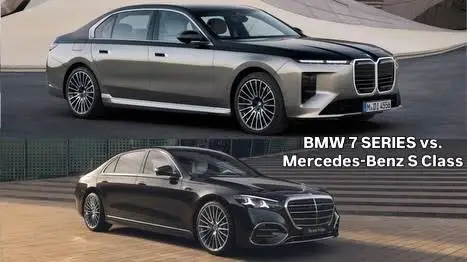
When it comes to full-size luxury sedans in India, two names dominate every conversation: the BMW 7 Series and the Mercedes-Benz S-Class. Both represent the pinnacle of their respective brands — chauffeur-friendly, tech-loaded, and built for buyers who want presence as much as performance. Here's how the BMW 740i stacks up against the Mercedes-Benz S-Class.
Price and Positioning
The BMW 740i M Sport is priced at roughly ₹1.81–1.85 crore (ex-showroom), making it the more accessible entry point into this segment. The Mercedes-Benz S-Class, on the other hand, has just received a 2026 facelift and now starts at ₹2.20 crore ex-showroom — a noticeable jump from the outgoing model. For now, the updated S-Class is sold exclusively in the S 450e plug-in hybrid guise in India, with the S 450 4Matic and S 350d diesel variants expected to join the lineup later. That price gap puts the BMW in a clearly stronger position for buyers who want flagship luxury without stretching into S-Class territory.
Powertrain and Performance
Under the hood, the 740i runs a 3.0-litre, six-cylinder turbo-petrol engine producing around 375bhp and 520Nm of torque, paired with mild-hybrid assistance and an 8-speed automatic gearbox driving the rear wheels. It's a refined, traditionally engineered setup that prioritizes smoothness and effortless cruising.
The new S-Class takes a different route. Its S 450e plug-in hybrid combines a turbo-petrol engine with an electric motor for a combined output of 435hp and 680Nm — noticeably stronger on paper — along with an electric-only driving range of around 100km. That means short city commutes can potentially be done on electric power alone, something the BMW simply can't match in its current 740i form. Buyers prioritizing outright power and electrified efficiency will find the Mercedes more compelling; those who prefer a familiar petrol/mild-hybrid character may lean BMW.
Interior and Technology
Both cars are built around the idea that the rear seat matters as much as the front. The BMW 740i, sold in long-wheelbase guise in India, offers generous rear legroom and is controlled through a 14.9-inch curved touchscreen running BMW's latest iDrive system, alongside ambient lighting and a genuinely plush cabin.
The Mercedes counters with its MBUX Superscreen — a triple-display setup spanning a 14.4-inch central touchscreen, a 12.3-inch passenger display, and a 12.3-inch digital instrument cluster, with virtually all controls moved to screen-based interfaces. Mercedes has also focused heavily on rear-seat comfort, with executive seating that reclines significantly for a near business-class experience. If cabin technology and rear-seat indulgence are the priority, the S-Class currently sets the benchmark.
Design and Road Presence
The 740i leans into BMW's bold, unapologetic design language, with a large kidney grille, sharp LED detailing, and a stance that's hard to miss. The S-Class takes a more understated approach — its facelift brings subtle styling revisions rather than a dramatic overhaul, favoring quiet authority over visual drama. This really comes down to personal taste: BMW for buyers who want to be noticed, Mercedes for those who prefer their luxury a little more discreet.
Which One Should You Choose?
If your priority is value within the flagship segment, a strong petrol/mild-hybrid drivetrain, and BMW's sportier road presence, the 740i makes a compelling case — especially with its price advantage of roughly ₹35–40 lakh over the new S-Class. If you're drawn to cutting-edge cabin tech, plug-in hybrid efficiency, and the last word in rear-seat luxury, the Mercedes-Benz S-Class — even at its new, higher price — remains the segment's gold standard.
Either way, both cars represent the very best of what German engineering offers in the luxury sedan space. The right choice really comes down to whether you value BMW's driver-focused character or the S-Class's reputation as the ultimate chauffeur-driven limousine.
Compare detailed listings, prices, and availability for both the BMW 7 Series and Mercedes-Benz S-Class on CarFinder.co.in — and find the flagship sedan that fits your garage.
